About Me
I am a final-year DPhil (PhD) candidate in Computer Science at the University of Oxford, supervised by Irina Voiculescu in the Medical Imaging group (OxMedIS) and funded by an EPSRC scholarship.
My research is on selective computation for computer vision: spending compute only where an image needs it. My published work covers token pruning for segmentation with vision transformers and landmark detection in X-rays, where my method won the MICCAI 2024 CL-Detection Challenge.
Before Oxford, my master's project at Durham, AnoDDPM, applied diffusion models to anomaly detection and has been cited more than 750 times. I also spent a year at Barclays as a graduate developer.

Course Information:
- University: University of Oxford
- Degree: DPhil (PhD) in Computer Science, 2023 - 2027 (expected)
- Group: Medical Imaging group (OxMedIS)
- Supervisor: Irina Voiculescu
Research Highlights:
- AnoDDPM (CVPR Workshops 2022): 750+ citations, 200+ GitHub stars
- Winner, MICCAI 2024 CL-Detection Challenge
- ICML Gold Reviewer Award; reviewer for NeurIPS, ICML, AAAI and MICCAI
- Lead demonstrator for Computer Vision at Oxford
- Papers at ICCV Workshops 2025, ICIAP 2025 and MICCAI Workshops 2026
- CVPR 2022 travel grant award
Notable Achievements & Hobbies:
- Oxford University American Football: wide receivers coach, 2023 - present
- Chorley Buccaneers American Football: assistant coach for the under-16s, 2017 - 2021
- National under-15 flag football side: coached to 2nd place in Italy
- Durham University flag football: captain 2020/21, president 2021/22
- Collingwood College rounders: president 2021/22, Sports Award 2021
- Collingwood College pool: B team 2019/20, A team 2021/22
- Mensa IQ: 99th percentile on the Culture Fair Scale
Core Skills
Tools and Libraries
Research
My research is on selective computation for computer vision: spending compute only where an image needs it. A full list of papers is on Google Scholar.
Research Areas
Efficient Vision Transformers
Token pruning for segmentation. Reg4Pru randomly drops tokens during training to improve inference reliability. A controlled study of train-time pruning (soft masking, Gumbel top-k, random routing and learned token scoring) on a DINOv3 ViT-S model shows that train-time pruning substantially improves segmentation over soft masking.
Landmark Detection
Domain alignment that selectively localises regions to improve multi-domain performance in cephalometric X-rays: the winning entry of the MICCAI 2024 CL-Detection Challenge. Studies of fairness and few-shot incremental landmark detection in collaboration with the University of Genoa.
Diffusion Models for Anomaly Detection
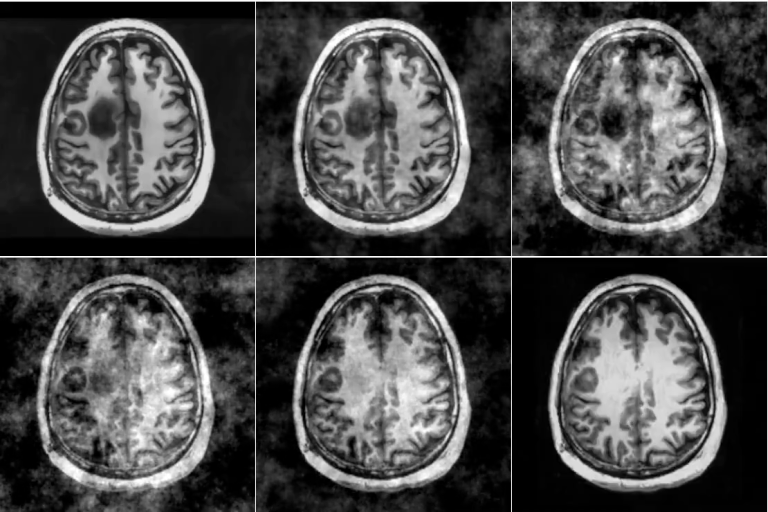
AnoDDPM, my master's project at Durham: a partial diffusion strategy with simplex noise for detecting anomalies in brain MRI, cited more than 750 times.
Awards and Service
Awards
- Winner, MICCAI 2024 CL-Detection Challenge: ranked first on both test sets for detecting 53 landmarks in cephalometric X-rays (department news)
- ICML Gold Reviewer Award
- CVPR 2022 travel grant award to present AnoDDPM in New Orleans
Service
- Reviewer for NeurIPS, ICML, AAAI, MICCAI, CVPR NTIRE, EMA4MICCAI and ISBI
- Write a weekly digest of new papers for the research group
Publications
AnoDDPM: Anomaly Detection with Denoising Diffusion Probabilistic Models using Simplex Noise
CVPR Workshops (NTIRE), 2022
J. Wyatt, A. Leach, S. M. Schmon, C. G. Willcocks
750+ citations on Google Scholar, 200+ GitHub stars
Paper Code Project page
How Do Train-Time Pruning Dynamics and Pruning Schedules Affect Retinal Vessel Segmentation?
MICCAI Workshops (EMA4MICCAI), 2026
J. Wyatt, I. Voiculescu
Controlled study: train-time pruning substantially improves segmentation over soft masking
Paper Code
Reg4Pru: Regularisation Through Random Token Routing for Token Pruning
arXiv preprint, 2026
J. Wyatt, R. Clark, I. Voiculescu
Randomly drops tokens during training to improve inference reliability
arXiv
Are X-Ray Landmark Detection Models Fair? A Preliminary Assessment and Mitigation Strategy
ICCV Workshops (STREAM), 2025
R. Di Via, M. Ciranni, D. Marinelli, A. Clement, N. Patel, J. Wyatt, F. Odone, M. Santacesaria, I. Voiculescu, V. P. Pastore
Paper
A Handful of Data: Evaluating Few-Shot Incremental Landmark Detection
ICIAP, 2025
N. Patel, A. Clement, J. Wyatt, R. Di Via, D. Marinelli, M. Ciranni, V. P. Pastore, I. Voiculescu
Paper
My Resume
Summary
Julian Wyatt
Final-year DPhil (PhD) candidate at the University of Oxford, researching selective computation for computer vision: efficient vision transformers, segmentation and landmark detection.
julian_wyatt@hotmail.com
Education
University of Oxford
2023 - 2027 (expected)
DPhil (PhD) in Computer Science, Medical Imaging group (OxMedIS)
Supervisor: Irina Voiculescu
Funding: EPSRC scholarship
College: St Anne's College
Relevant Modules:
Graph Representation Learning, Uncertainty in Deep Learning
Durham University
2018 - 2022
MEng Computer Science, First Class Honours
Year 1 - averaged 78%
Year 2 - averaged 78%
Year 3 - averaged 73%
Year 4 - averaged 78%
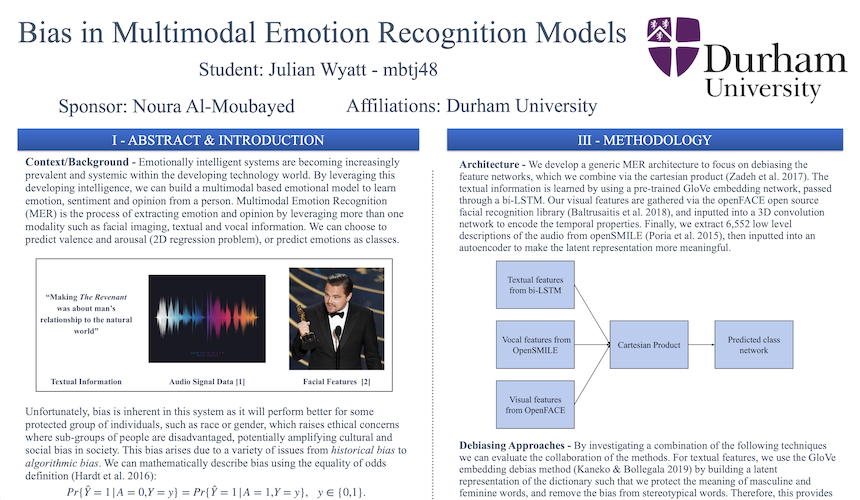
Project Preparation: Bias in Multimodal
Emotion Recognition
Relevant Modules:
Year 4:
Advanced Computer Vision, Natural Language Processing,
Advanced Computer Graphics and Visualisation
Year 3:
Computer
Vision, Deep Learning and Reinforcement Learning, Recommender
Systems, Master's Project Preparation
Year 2:
Software
Methodologies - (Machine Learning, Computer Graphics, AI Search, Image Processing),
Networks and Systems - (Networks, Distributed Systems, Security,
Compiler Design), Programming Paradigms - (C, Java, Haskell), Software
Engineering
Year 1:
Computer Systems, Algorithms and Data
Structures, Programming - (OOP in JS, NodeJS)
UTC@MediaCityUK
2016 - 2018
Awards: Awarded Best Male Student, Best Physicist, Best Mobile Game developer, and nominated for Best Mathematician and Best Game Developer
Rivington and Blackrod High School
2011 - 2016
Awards: Leigh Bromwell Trust prize for Maths and Excellence in Science
Professional Experience
University of Oxford
Teaching
Practical Demonstrator (Teaching Assistant)
- Lead demonstrator for Computer Vision (2025/26, 2026/27)
- Demonstrator for Artificial Intelligence, Machine Learning, Uncertainty in Deep Learning, and Deep Learning in Healthcare
Barclays
August 2022 - September 2023
Technology Developer Analyst Graduate
- Tech lead for an early-careers group project that won Most Innovative App: a full-stack internal tool with personalised recommendations, built with Django and React and deployed with Docker and Kubernetes
- Took the tool from idea to a production pilot that met its sign-up target; recognised by Managing Directors, including the CIO of Business Banking
- Tech lead for a second internal project applying deep learning, from idea to early prototype
- Tested, then developed for, an automated contract-generation system for consumer device financing: API and document regression testing, followed by server-side .NET development
- Worked with another graduate to migrate an external Java Docker project for internal use
Barclays
June 2021 - August 2021
Customer Digital & Data Developer Intern
- Built a proof of concept using AWS OCR and NLP services for a product evaluation, in a small team
- Wrote flowcharts and requirements to begin automating the "New to Bank" joiner application
- Led and presented a team pitch on improving the mobile live-chat service
Barclays
July 2020 - August 2020
Mainframe Connectivity Developer Intern
- Migrated internal users of a mainframe application to a load-balanced system
- Updated branch device configurations and removed decommissioned connections
Software Engineering Group Project
2019 - 2020
RT Projects Database and Register Solution
For the Software Engineering module in the second year of my degree, my team was tasked to reach out to a local charity and develop software for them. Our Charity, RT Projects, is a creative mental health charity based in Newcastle. They wished to improve their data collection and statistical measurements with a small application.
- Collaboratively developed using Python, Git and Trello
- Worked as team lead - ensured the team was on track
- Primarily developed database integration through linking Python and SQL, as well as Dropbox API interaction
My Portfolio
Please see the links below for my collection of relevant works from 2017 onwards.
- All
- Python
- Web
- Games Design